
Custom vs ready-made ERP for a small manufacturer in India
By Milan Tailor, founder of CodBizz · Updated 21 October 2026 · 6 min read
Short answer
Buy a ready-made ERP or accounting package (Tally, Busy, Zoho and similar) if your process is standard and its demo handles your real workflow without workarounds. Build custom when your production flow, units, stock locations or approvals do not fit and the workarounds cost you time every day. Many small manufacturers do both: they keep Tally for statutory accounts and add a custom system for production and stock.
Ready-made and custom ERP at a glance
Neither is better in general. The right choice depends on how standard your process is and how much of it lives in spreadsheets and people’s heads today.
| Ready-made (Tally, Busy, Zoho) | Custom-built | |
|---|---|---|
| Upfront cost | Lower. Licence or subscription. | Higher. You pay for the build. |
| Time to start | Days to weeks. | Weeks to months, best done in phases. |
| Fit to your process | You adapt your process to the software, or pay for customisation. | The software is shaped to your process. |
| Changes later | Follow the vendor roadmap or a partner. | You decide the priorities. |
| Ownership | Vendor controls the product and its updates. | With us, you own the code and data. |
| Best when | Your process is standard and the demo fits. | Your process is unusual, or several workflows must sit in one system. |
Seven signs you have outgrown your current software
- The same data is typed two or three times: in Excel, in your accounts software and in WhatsApp messages.
- Stock in the software does not match what is on the shop floor or in the godown.
- Production planning, meaning what to make and how much raw material it needs, lives in one person’s head or in a spreadsheet.
- You run more than one godown or plant and track transfers by hand.
- Quotations, orders and invoices are re-typed from one document into the next.
- You cannot see margin by product, customer outstanding or low stock without asking somebody.
- A few staff members know the workarounds, and the business stalls when they are absent.
What a small manufacturer should expect from an ERP
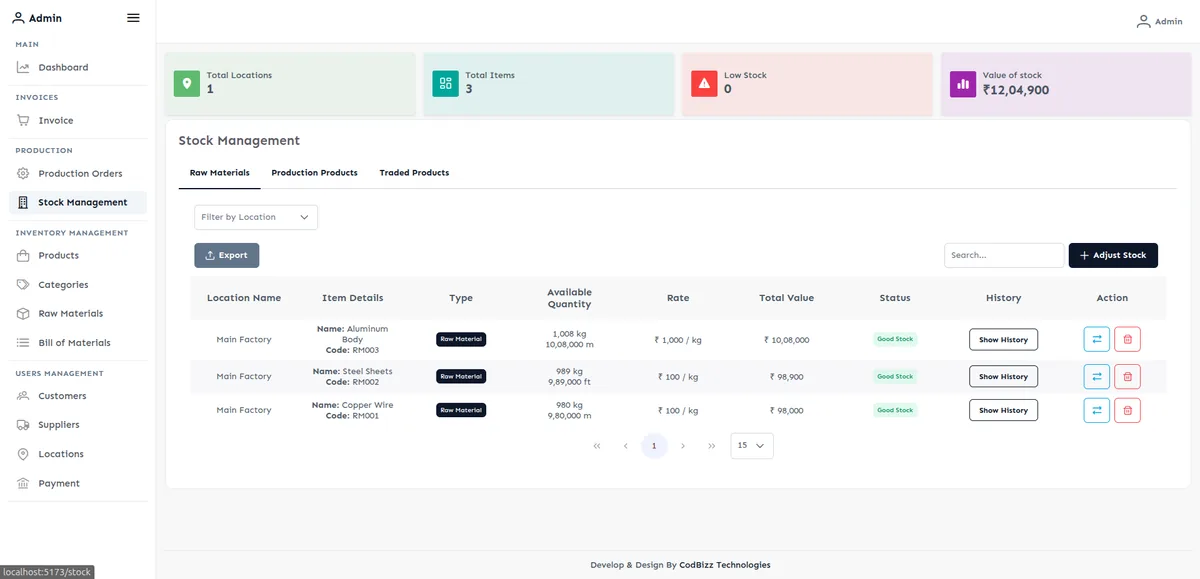
These are the modules we built for DC Motors, a manufacturing business in India. The system is in use and maintained by the same team that built it.
- A bill of materials for each product and production orders that use up raw material.
- Stock by location, with low-stock alerts and transfers between locations.
- Purchase, supplier ledgers and customer ledgers with outstanding.
- Sales invoices you can export as PDF.
- A dashboard with the numbers the owner checks every day.
How to decide in one week
- Write down your five most important workflows, for example purchase to stock, production, quotation to invoice, collections and stock transfer.
- Ask each vendor to demonstrate those five workflows on your own scenarios, not a standard demo.
- Count the workarounds each option needs. Every workaround is a daily cost.
- Compare three-year cost: licences per user, customisation, support, and the cost of staff time lost to workarounds.
- Ask who owns the data and the code, and whether you can export everything.
- Start with one module, the one that hurts most, and add the rest once it works.
The hybrid option many factories choose
You do not have to replace your accounts software. A common setup keeps Tally or Busy for statutory accounts and GST filing, and adds a purpose-built system for production, stock and sales. The two exchange data, so the accountant keeps working in a familiar tool while the factory gets a system that matches its process.
Frequently asked questions
Is Tally enough for a small manufacturer?
Tally is strong for accounts, GST and standard inventory. Manufacturers who need production orders, a bill of materials, several stock locations and approvals often add a separate system or customise it, depending on how it is set up. Test your real workflow in a demo before you decide.
How long does a custom ERP take to build?
It depends on scope. We start with the one workflow that hurts most, release it first and add modules after that. Ask any vendor for a phased plan with dates for the first usable version.
What does a custom ERP cost?
We work on a flat monthly retainer: Starter Partner from $1,200/month, Growth Partner from $2,000/month and Full Tech Team from $3,500/month. We recommend a plan after a free discovery call, once we understand your scope.
Do we own the code and data?
With us, yes. All code lives in your repositories and your cloud accounts, so you can leave at any time with everything intact.
Want a straight answer for your case?
Book a free 30-minute call or send the form. We tell you honestly what fits, including when you do not need us.
Book a Free Discovery Call →Talk to us about your ERP
Tell us how your factory works. We reply within one business day.

