
Introduction
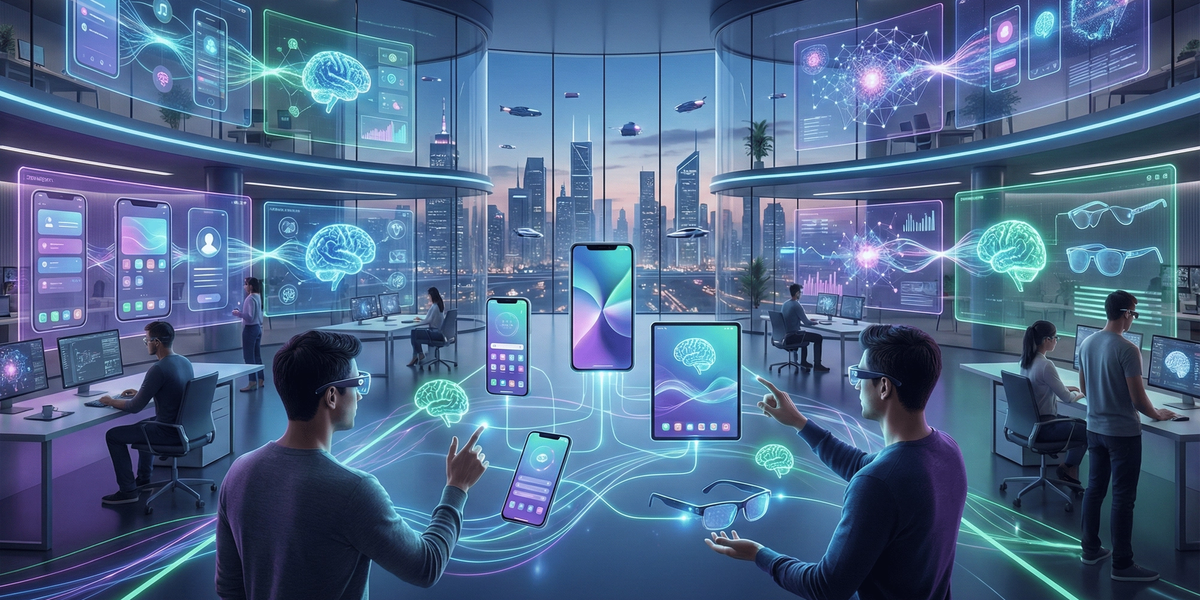
The landscape of mobile app development is experiencing a seismic shift in 2026. Flutter has evolved from a promising cross-platform framework into a mature, production-ready powerhouse, while Artificial Intelligence has moved from being a "nice-to-have" feature to an essential component of modern applications.
If you're building mobile apps in 2026, understanding these trends isn't optional—it's critical to staying competitive. Let's dive into the most significant developments reshaping the industry.
1. AI-Powered Flutter Applications: The New Standard
The Shift from Feature to Foundation
Artificial Intelligence is no longer just a buzzword or an experimental add-on. In 2026, AI integration is a core expectation for modern applications, particularly in sectors like fintech, healthcare, and SaaS.
What's Possible Now
Flutter apps in 2026 commonly include:
- Intelligent Chatbots: Natural language processing that actually understands context
- Personalized Recommendations: Real-time content adaptation based on user behavior
- Voice Recognition: Seamless voice-first interactions
- Predictive Analytics: Anticipating user needs before they arise
- Smart Automation: Reducing manual tasks through intelligent workflows
Real-World Impact
Over 60% of mobile applications now integrate AI-driven functionality. This isn't just about adding features—it's about fundamentally reimagining how users interact with your app.
Example Use Cases:
- Healthcare Apps: AI-powered symptom checkers and personalized treatment plans
- Fintech Apps: Fraud detection and intelligent investment recommendations
- E-commerce Apps: Dynamic pricing and personalized shopping experiences
2. On-Device AI: Privacy Meets Performance
The Game-Changer
One of the most significant trends in 2026 is the shift to on-device AI processing. Instead of sending data to cloud servers, modern smartphones process AI directly on the device using specialized neural processing units (NPUs) and tensor processing units (TPUs).
Why This Matters
Enhanced Privacy: Your sensitive data never leaves your device Blazing Speed: No network latency means instant responses Offline Functionality: AI features work even without internet connection Reduced Costs: Less reliance on expensive cloud infrastructure
Flutter's Advantage
Flutter's architecture makes it ideal for integrating on-device AI models. With packages like TensorFlow Lite and ML Kit, developers can easily implement:
- Image recognition
- Natural language processing
- Gesture detection
- Real-time translation
3. Flutter Web: Production-Ready at Last
The Breakthrough
After years of development, Flutter for web is now truly production-ready in 2026. This isn't just about rendering widgets in a browser—it's about delivering a complete, SEO-friendly, performant web experience.
What Changed
- Proper SEO Support: Search engines can now correctly index Flutter web apps
- Faster Loading Speeds: Optimized rendering and code splitting
- Better Accessibility: Full ARIA support and keyboard navigation
- Progressive Web Apps (PWAs): Offline-first experiences that feel native
The Business Case
Companies are now confidently building their entire digital presence with Flutter:
- Mobile apps (iOS & Android)
- Web applications
- Desktop software (Windows, macOS, Linux)
- Embedded systems
One codebase. Every platform. Consistent experience.
4. Performance Improvements: Faster Than Ever
Impeller: The New Standard
The Impeller rendering engine is now the default in Flutter, delivering:
- Instant App Startup: Apps launch almost immediately, even on older devices
- Smoother Animations: 60fps is the baseline, 120fps is achievable
- Better Memory Management: Reduced RAM usage across all devices
- Improved Battery Life: More efficient rendering means longer battery life
Developer Experience Enhancements
Hot Reload & Hot Restart: Near-instantaneous code changes Smarter IDE Integration: Better auto-completion and error detection Enhanced DevTools: More powerful debugging and performance profiling
5. Dart 3.10+: The Language Evolves
Key Improvements
Better Null Safety: Catches more potential errors before runtime Pattern Matching: Simplifies complex conditional logic Records & Destructuring: Less boilerplate, cleaner code
Example: Before vs After
Before (Dart 2.x):
6. Cross-Platform Development: The ROI is Clear
The Numbers Don't Lie
Cross-platform development with Flutter in 2026 delivers:
- 50-80% reduction in development effort
- 30-40% faster time to market
- Consistent UX across all platforms
- Single team instead of multiple platform-specific teams
Market Validation
The cross-platform market is projected to exceed $546.7 billion by 2033, with Flutter leading the charge as the most popular framework.
7. Security & Compliance: Built-In, Not Bolted-On
The New Reality
With regulations like GDPR, CCPA, and emerging privacy laws, security is no longer optional. Flutter in 2026 includes robust support for:
- Encrypted Storage: Secure local data persistence
- Biometric Authentication: Face ID, Touch ID, fingerprint scanning
- Secure Network Communication: Certificate pinning and end-to-end encryption
- Privacy-First Architecture: Data minimization and user consent management
8. Emerging Integrations
IoT & Device Connectivity
Flutter apps are increasingly connecting with:
- Smart home devices
- Wearables (smartwatches, fitness trackers)
- Medical sensors
- Industrial IoT equipment
AR/VR Experiences
Augmented and Virtual Reality are no longer just for gaming. Flutter is powering AR/VR experiences in:
- Retail: Virtual try-ons and showrooms
- Real Estate: Virtual property tours
- Healthcare: Surgical training and patient education
- Education: Immersive learning experiences
Super Apps
The "super app" trend—combining multiple services into one platform—is accelerating. Flutter's scalable architecture makes it ideal for building apps that integrate:
- Payments
- E-commerce
- Messaging
- Social features
- Booking services
9. Low-Code & No-Code: Democratizing Development
The Trend
Low-code and no-code platforms built on Flutter are enabling:
- Faster Prototyping: From idea to MVP in days, not months
- Smaller Teams: Non-technical stakeholders can contribute
- Rapid Iteration: Quick A/B testing and feature experimentation
When to Use
- MVPs and proof-of-concepts
- Internal business tools
- Simple content-driven apps
- Rapid prototyping before custom development
10. Voice-First Interactions
The Shift
Users are increasingly preferring voice commands over typing. Flutter apps in 2026 are designed for:
- Natural Language Processing: Understanding context and intent
- Multi-Language Support: Real-time translation and localization
- Accessibility: Making apps usable for everyone
- Hands-Free Operation: Perfect for driving, cooking, or multitasking
What This Means for Your Business
If You're Planning a New App
Choose Flutter if you want:
- Cross-platform reach with a single codebase
- Fast development and iteration cycles
- Modern, beautiful UI out of the box
- AI integration without complexity
- Future-proof technology stack
If You Have an Existing App
Consider Flutter Migration if:
- You're maintaining separate iOS and Android codebases
- Development is slow and expensive
- You want to add web or desktop support
- You need better performance
- You want to integrate AI features
The CodBizz Advantage
At CodBizz, we've been at the forefront of Flutter development since its early days. In 2026, we're leveraging these latest trends to deliver:
- 40% faster development through AI-assisted coding
- Production-ready apps across mobile, web, and desktop
- On-device AI integration for privacy and performance
- Future-proof architecture that scales with your business
Our Expertise Includes:
✅ Flutter app development (iOS, Android, Web, Desktop) ✅ AI integration and machine learning ✅ App migration from native to Flutter ✅ Performance optimization ✅ Security and compliance implementation ✅ IoT and device connectivity
Conclusion: The Future is Now
The convergence of Flutter's maturity and AI's capabilities is creating unprecedented opportunities for businesses. Whether you're building a new app or modernizing an existing one, 2026 is the perfect time to embrace these technologies.
The question isn't whether to adopt these trends—it's how quickly you can implement them to stay ahead of the competition.
Ready to Build the Future?
Let's discuss how Flutter and AI can transform your business. Our team of experts is ready to help you:
- Evaluate your current tech stack
- Plan your Flutter migration strategy
- Integrate AI capabilities
- Build your next-generation app


